
In a commentary for Mind.ua, Managing Partner Kostyantyn Gamkrelidze explains how to avoid financial losses when purchasing prohibited equipment.
Purchasing a gas boiler is, for many Ukrainian consumers, an investment for 10–15 years. In times of energy instability, consumers naturally seek cost savings — and this is where a significant risk arises. The market still offers so-called “turbocharged gas boilers,” also referred to as “conventional gas boilers.” These models are typically UAH 3,000–6,000 cheaper than condensing boilers, which often leads buyers to choose them.
However, is this truly a reasonable decision? Are there additional factors that should prompt reconsideration before opting for a lower-priced alternative? In reality, consumers are often sold equipment that has already been phased out of regulated markets but still remains available in Ukrainian warehouses.
Gas boilers with a capacity of up to 70 kW intended for household use are subject to state market surveillance. As in previous years, such products are included in the Sectoral Market Surveillance Plan for 2026 as high-risk products, meaning they are subject to enhanced monitoring and inspections by the State Service of Ukraine on Food Safety and Consumer Protection and customs authorities.
Technical requirements for gas boilers — and the prohibition of non-compliant products — were introduced in August 2022 following the adoption of the Ecodesign Technical Regulation approved by Resolution of the Cabinet of Ministers No. 1184. However, due to the introduction of martial law in 2022, the government imposed a moratorium on inspections, which was lifted only in 2025.
This Regulation establishes minimum thresholds for seasonal energy efficiency as well as emissions of nitrogen oxides (NOx), a hazardous pollutant.
Only condensing boilers comply with these ecodesign requirements.
Information on inspection results is periodically published on the official website of the State Service, which also contains a list of 128 gas boiler models from 22 brands prohibited for sale.
For example, in December 2025, the State Service and Lviv Customs prevented the importation of over one thousand units of substandard gas boilers from various brands, including Ferroli, Immergas, and Hi-Therm. This is only one of many similar enforcement cases.
If such a boiler is purchased, the consumer has the right to file a complaint with the competent authority, including claims for damages and product recall.
Non-condensing (conventional or turbocharged) gas boilers:
Importantly, in such cases, the consumer will likely be unable to return the product, as the statutory 14-day return period will have expired.
First and foremost, consumers should verify whether the selected boiler model appears on the aforementioned official list of prohibited products.
However, this list is not exhaustive. There have been cases where unscrupulous manufacturers or distributors deliberately alter model names to avoid matching listed products.
As an additional safeguard, it is recommended to verify: the energy label (energy efficiency class), accompanying documentation (user manual, installation manual, technical specifications), the nameplate (technical data plate) on the device.
The primary indicators to consider when choosing compliant and high-quality equipment are:
Each boiler must display an energy label:
For Class B, it is essential to verify that the parameter “Seasonal space heating energy efficiency (ηₛ)” is at least 86%. If lower — the boiler is prohibited and will not be connected to the gas network.
An exception applies to atmospheric boilers (Type B1), which may have Class C, provided their efficiency is at least 75%.
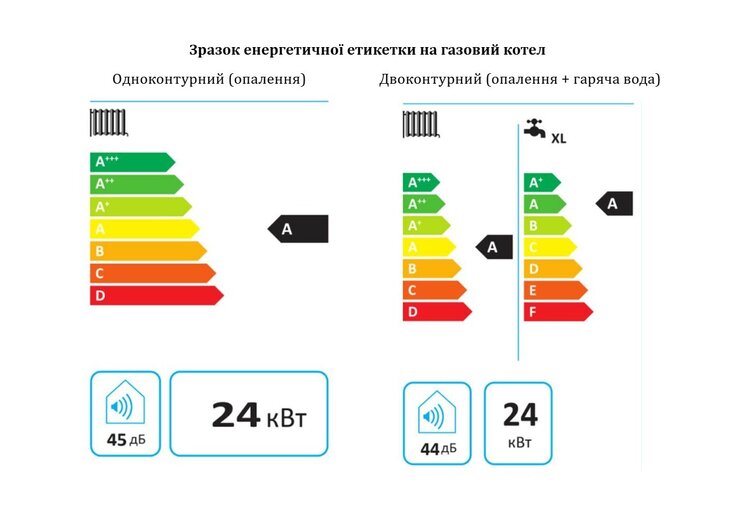
The NOx emissions parameter applies to all types of gas boilers and must not exceed 56 mg/kWh.
If this threshold is exceeded, the boiler is prohibited for sale and use, and the DSO will refuse connection to the gas network.
This parameter may also be indicated as “NOx Class” or “Emission Class” (only Class 6 is compliant). Lower classes indicate prohibited equipment.
If neither energy efficiency nor NOx emissions data are provided in documentation or labeling, this is a strong indication of concealment of material information and potential consumer misrepresentation.
Purchasing a cheaper turbocharged boiler may appear cost-effective today, but in the long term it may result in: financial losses; legal complications; increased energy consumption or even inability to connect the equipment to the gas network.
Because purchasing equipment does not guarantee its lawful installation or operation.